
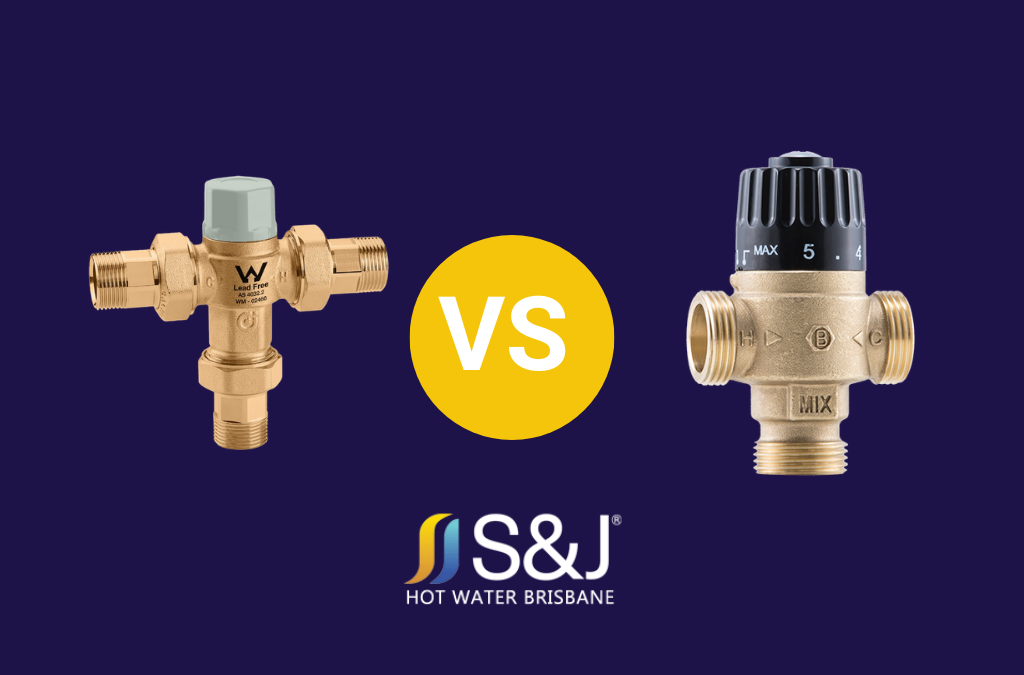
The risk of scalding from your home’s own hot water supply is real – particularly for young children and the elderly. And both a thermostatic mixing valve and a tempering valve exist to address that risk. But were you aware not only that they aren’t the exact same thing said in different ways, but that they don’t do what they do in the same way either? In fact, they’re not even suited to the same situations – and in some cases the regulations around which one you need aren’t optional. Confused? The thermostatic mixing valve vs tempering valve question is definitely worth understanding properly before you make any decision about what to do next.
What are they, in simple terms?
First things first – before getting into the differences between these vital components of your hot water setup at home, we should define each one clearly:
What is a tempering valve?
If you’ve got a standard Australian home, you almost certainly have one of these.
And the answer to ‘what is it’ really comes down to this:
It’s a device that mixes hot and cold water to ensure the water coming out of your taps doesn’t exceed a set maximum temperature – typically 50 °C in bathrooms.
It’s a simple, mechanical solution. Once set properly, it limits how hot the water can get. That’s why the device, often referring to in the industry as a hot water tempering valve, is required in most domestic installations for safety and compliance.
What is a thermostatic mixing valve?
As for the thermostatic mixing valve, basically it takes the process a step further.
A thermostatic mixing valve (often referred to as a TMV valve), also mixes hot and cold water – but instead of just limiting temperature, it actively controls it.
That means it adjusts in real time if:
- The hot water temperature changes
- The pressure fluctuates
- The cold water supply varies.
This type of plumbing TMV setup is designed for environments where temperature stability is critical.
6 Key differences that actually matter
If you’re feeling a bit confused, don’t worry – this is where we’ll clear it all up. Instead of thinking of them as similar products or devices, it’s easier to compare how they behave in real-world use.
Let’s dive into the differences:
1. How they control temperature
A tempering valve is set to cap the maximum temperature. It blends hot and cold water to stay under that limit, but it doesn’t actively respond to changes once installed.
A TMV, on the other hand, constantly adjusts. It monitors the output temperature and makes small corrections to keep it steady.
That’s the fundamental difference in the tempering valve vs thermostatic mixing valve discussion – one limits, the other regulates.
2. Accuracy of the water temperature
With a tempering valve, the water temperature can vary slightly depending on what else is happening in the system.
With a TMV, the output is far more consistent. It’s designed to deliver a stable temperature, even if someone turns on another tap or the system fluctuates.
That precision is the main reason TMV valves are used in more controlled environments.
3. Response to pressure and temperature changes
It’s at this point where the gap becomes more obvious.
If your hot water pressure drops or cold water pressure increases, a tempering valve won’t actively compensate. You might notice small temperature changes at the tap.
A TMV reacts immediately. It adjusts the mix to maintain the set temperature regardless of what’s happening in the background.
4. Where each one is typically used
In most Australian homes, a tempering valve is the standard. It meets safety requirements and does the job effectively for everyday use.
TMVs are typically found in places like:
- Hospitals
- Aged care facilities
- Childcare centres.
In other words, environments where even small temperature variations can pose a risk.
That’s why when people compare tempering valve vs mixing valve – because the context matters just as much as the device itself.
5. Cost & complexity
Let’s say it up front.
Tempering valves are:
- Simpler
- More affordable
- Easier to install and maintain.
And that’s a big part of why they’re used in residential systems.
A TMV, on the other hand, is more complex.
It requires:
- More precise setup
- Regular maintenance
- And comes at a higher cost.
And that makes sense, given the level of control it provides.
6. Compliance & requirements
For standard homes in Australia, a tempering valve is typically what’s required to meet regulations for safe hot water delivery.
TMVs are mandated in certain environments where higher levels of protection are needed.
So while both exist for safety, they’re designed to meet different compliance needs.
So which one do you actually need?
Now we’re getting to the part most people care about.
In the vast majority of cases – if you’re in a typical home – you don’t need to overthink it at all. A tempering valve is the correct and compliant solution.
But there are situations where a TMV makes sense – for example, if you’re dealing with a property that has:
- Specific safety requirements
- Vulnerable occupants
- A more complex setup.
The important thing is understanding that these aren’t interchangeable. Choosing between a thermostatic mixing valve vs tempering valve isn’t about picking the ‘better’ or ‘worse’ option – it’s about choosing the right one for your situation.
Why this matters more than people realise
Because these valves sit out of sight, they’re easy to ignore.
But they directly affect:
- How safe your hot water is
- How consistent your temperature feels
- How your system performs overall.
Installing the wrong type – or installing it incorrectly – can lead to inconsistent temperatures or compliance issues, and also unnecessary costs.
Getting it right without overcomplicating it
You don’t need to become an expert in TMV valve setups or dive too deep into technical specs at all.
What actually matters is having the system assessed properly and making sure the right valve is installed for your setup – whether that’s a standard tempering valve or a more precise thermostatic mixing valve.
At S&J Hot Water Brisbane, the team works with both types every day. From diagnosing temperature issues, increasing hot water pressure, to installing and servicing the right system, the goal is to make sure your hot water is safe, reliable, and working exactly as it should.
If you’re unsure what’s installed – or whether it’s performing properly – it’s worth getting it checked.
Call now or book online instantly to get your hot water sorted quickly and properly.
Related posts:
 How To Tell If Your Hot Water Tempering Valve Needs Attention
 Understanding Hot Water Temperature QLD: All You Need To Know
 How To Clear A Blocked Hot Water Pipe In Shower
 How To Increase Hot Water Pressure: 7 Mistakes To Avoid
 What Is A Solar Hot Water Booster Switch: 10 Common Questions
 Why Is My Hot Water Cloudy? Causes, Concerns & Fixes
