
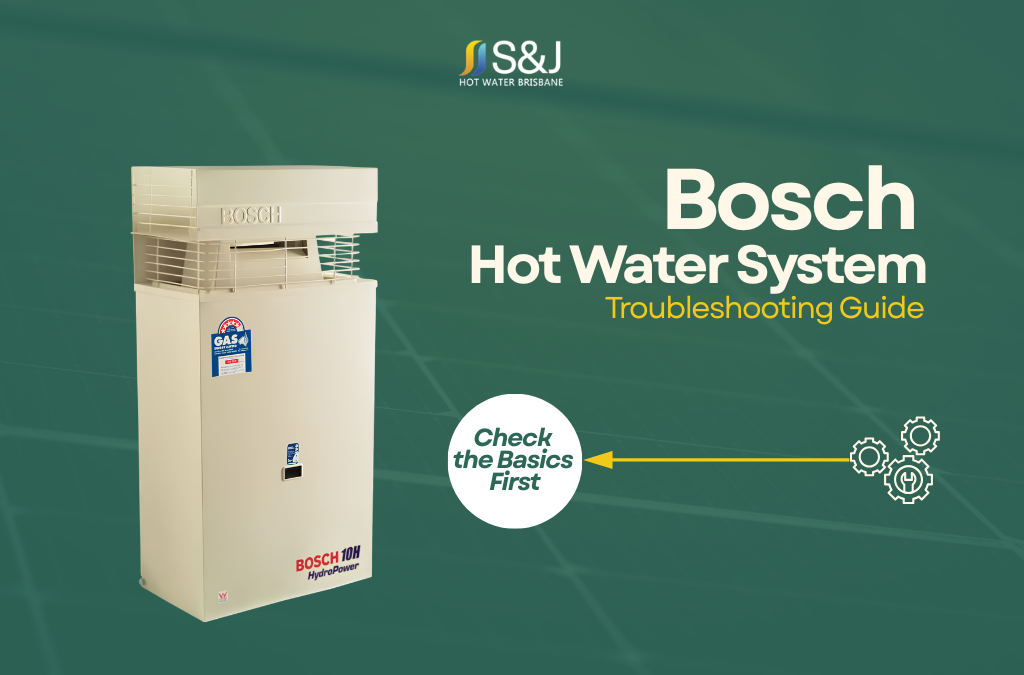
Did you know Bosch pioneered continuous flow hot water technology? Even more amazing is that this great German brand did this all the way back in the late 1800s. But even here in Australia, Bosch has been operating for more than 50 years now – and that history means there are several genuinely different Bosch technologies still running in Aussie homes today. So if you’re struggling with a Bosch hot water system not working as it should, the solution really does depend on exactly what you’ve got set up at your place.
We’ve put together this Bosch hot water system troubleshooting guide based on the real questions people just like you ask us all the time.
Let’s dive right in:
1. What type of Bosch system do I actually have?
Bosch’s Australian range covers more ground than most hot water brands.
There’s the:
- Electronic ignition Highflow series (17e, 21e, 26e), which needs a power point to spark ignition and typically carries a 5.5-star or better efficiency rating.
- HydroPower range, which uses water flow itself to spin a small turbine and ignite the burner, needing no power point or batteries at all – and eliminating pilot outages on windy days entirely.
- Standing pilot mechanical range, which you may have if your property is on the older side. You’ll recognise it by the small flame that’s burning constantly
- Premium OptiFlow range, which adds Bluetooth control on top of continuous flow gas heating, letting both homeowners and technicians monitor and adjust the system remotely.
But wait, there’s more!
- On the electric side, the Tronic storage range comes in Medium, Tall and Lowboy formats from 80L to 400L, with a vitreous enamel lined tank and a seven-year cylinder warranty.
- And the Compress 3000 is Bosch’s heat pump, pulling heat from the air rather than burning gas or running a standard element.
Checking your unit’s data plate or model sticker for these names is the fastest way to work out which answer below actually applies to you.
2. My Bosch hot water system is not working at all. Where do I start?
Start with the basics before assuming a major fault.
For any gas hot water continuous-flow unit, confirm the gas supply is on and the isolation valve hasn’t been shut off, which sometimes happens after other trades’ work nearby.
For electronic hot water ignition models like the 17e, 21e or 26e, check the power point the unit is plugged into and the relevant circuit breaker, since these units simply won’t ignite without power.
For HydroPower models, there’s no power point to check, so the more likely cause is a blocked inlet strainer or debris interfering with the internal turbine that generates ignition.
3. My Bosch gas hot water system is not working. What’s actually wrong?
If you have a Bosch gas hot water system not working, the diagnosis depends heavily on which ignition type you have.
Standing pilot models rely on a small constant flame – if it’s gone out, most units have a visible relighting procedure on the front panel, and repeated outages usually point to wind exposure or a failing thermocouple.
HydroPower units have no pilot to check at all, since ignition depends entirely on water flow through the internal turbine, so a fault here is more likely mechanical than electrical.
Electronic ignition models depend on both gas supply and a working power connection, so if the display shows no life at all, power is the first thing to rule out before assuming a gas fault.
4. My Bosch electric hot water system is not working. What should I check?
Bosch electric hot water system not working? If it’s on the Tronic range, the issue is often traced back to the high-temperature thermal cutout – a safety device that trips if the water overheats.
To check it:
- Disconnect the power supply first
- Remove the access cover on the unit
- Look for a reset button at the centre of the cutout.
Pressing this and reconnecting the power resolves a surprising number of ‘no hot water’ calls on electric storage units. But be warned: repeated tripping points to a genuine fault, often a failing thermostat or element, and that needs a licensed technician rather than repeated resets.
5. Why is my continuous flow water too hot, too cold, or inconsistent?
On electronic ignition and OptiFlow models, temperature is usually adjustable via a wall controller or, on OptiFlow, the companion app.
Inconsistent hot water temperature during multi-tap use is common on continuous flow generally, since flow rate affects how the unit modulates gas input. Running two outlets at once can occasionally drop performance below what a single tap delivers.
6. Is Bosch hot water system troubleshooting something I can safely do myself?
Some of it, yes.
- Checking power points
- Checking circuit breakers
- Checking gas isolation valves
- The electric thermal cutout reset.
These are all reasonable to check without a licence.
But anything involving the gas line itself, or the ignition components, heating elements or the heat exchanger on a Compress 3000 heat pump, should definitely be left to a licensed technician – both for safety and because Bosch’s warranty terms generally require licensed servicing to remain valid.
7. When should I call a licensed technician?
If you’ve checked the basics relevant to your system type and the fault hasn’t cleared, or if you smell gas at any point, it’s time to stop troubleshooting and call a professional.
Bosch hot water repairs across Brisbane
S&J Hot Water Brisbane services the full Bosch range, from HydroPower and electronic ignition continuous flow through to Tronic electric storage and the Compress 3000 heat pump. Our technicians work across Brisbane Northside, Brisbane Southside, Logan, Moreton Bay, Redland Bay and Ipswich, with same-day availability and fixed pricing on every job.
So whether your system is a straightforward reset or a genuine component failure, we diagnose the actual cause rather than guessing. Call today for fast, reliable Bosch hot water repairs backed by a genuine workmanship guarantee.
Related posts:
 An Honest Bosch Hot Water System Review
 AquaMAX Hot Water Troubleshooting: Step-By-Step Guide
 Electric Hot Water System Not Working? Try Our 9-Step Guide
 A 10-Step, Easy Troubleshooting Guide For Rinnai Hot Water
 A Full Guide To Troubleshooting Dux Hot Water Systems
 A 10-Step DIY Troubleshooting Guide For All Rheem Hot Water Systems
